Earth or Mars: Image 1
Verdict: Mars — regolith, rover-like tracks, and hardware shadow geometry.
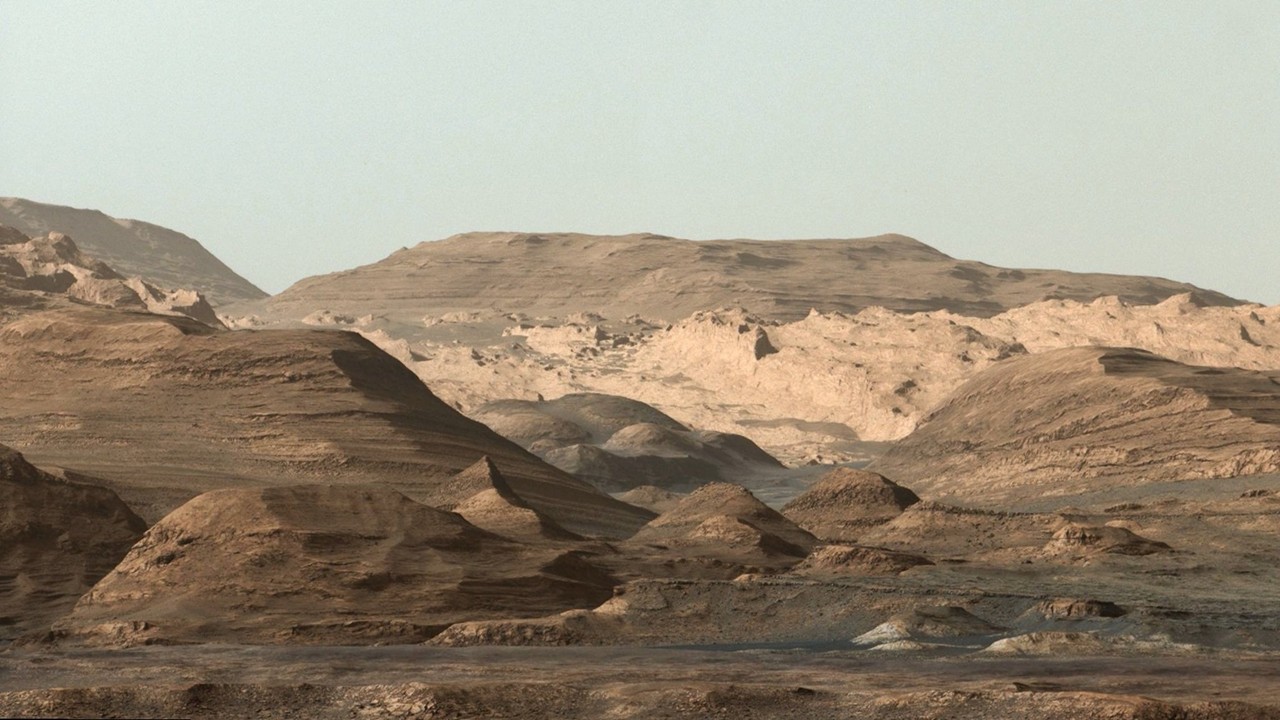
Methodology (3x3)
We identify Entities (O), Behaviors (B), and Emergents (e), then weigh Earth vs. Mars cues from the emergent structure and physical context.
3x3 analysis (O/B/e)
Entities (O)
- Regolith surface
- Rock fragment cluster
- Surface track imprint
- Shadow projection
Behaviors (B)
- Sediment redistribution
- Surface deformation (track formation)
- Light occlusion (shadow geometry)
Emergents (e)
- Surface patterning
- Directional path signature
- Depth perception from shadow contrast
[
  {
    "id": "TO001",
    "matrix_index": 0,
    "name": "Regolith Surface",
    "description": "Fine-grained dusty planetary soil covering terrain",
    "attributes": ["granular", "low cohesion", "oxidized"],
    "boundary_condition": "continuous ground layer",
    "part_classification": "proper",
    "metastability_measure": 0.72
  },
  {
    "id": "TO002",
    "matrix_index": 1,
    "name": "Rock Fragments / Boulders",
    "description": "Scattered lithic fragments embedded in regolith",
    "attributes": ["angular", "varied size", "erosion-shaped"],
    "boundary_condition": "discrete solid boundaries",
    "part_classification": "proper",
    "metastability_measure": 0.88
  },
  {
    "id": "TO003",
    "matrix_index": 2,
    "name": "Surface Track / Disturbance",
    "description": "Linear mechanical disturbance in soil",
    "attributes": ["linear", "shallow", "directional"],
    "boundary_condition": "localized deformation path",
    "part_classification": "transitional",
    "metastability_measure": 0.40
  },
  {
    "id": "TO004",
    "matrix_index": 3,
    "name": "Shadow Projection",
    "description": "Triangular shadow cast across surface",
    "attributes": ["optical", "geometric", "light-dependent"],
    "boundary_condition": "light occlusion boundary",
    "part_classification": "improper",
    "metastability_measure": 0.12
  }
]
Why this suggests Mars
- Fine, uniform regolith with oxidized tones and no vegetation
- Rover-like track imprint and hardware-like shadow geometry
- Minimal atmospheric haze and no moisture/weathering cues
Verdict: Mars
Correct identification: Yes
Detailed Analysis
Key Relationships
| ID0 | Description | Relationship | ID1 | Description |
|---|---|---|---|---|
| TO001 | Regolith Surface | DRIVES | TB001 | Sediment Redistribution |
| TO002 | Rock Fragment Cluster | FCILITATES | Te001 | Surface Patterning |
| TO003 | Surface Track Imprint | RESULTS_IN | Te002 | Directional Path Signature |
| TO004 | Shadow Projection | RESULTS_IN | Te003 | Spatial Depth Perception |
| TB002 | Surface Deformation | PRODUCES | TO003 | Surface Track Imprint |
| TB003 | Light Occlusion | PRODUCES | TO004 | Shadow Projection |
Insights
-
No biological or adaptive structures → purely physical-geophysical system.
-
Emergence is perceptual + structural, not agent-based:
- Patterns, depth, directionality are emergent phenomena.
- Track imprint = transitional object:
- Will decay via entropy (wind erosion, sediment flow).
- Shadow = improper part:
- Exists within boundary but not functionally integrated.
- Entropy driver:
- Soil redistribution + erosion = irreversible state change (ΔS ≥ 0).
Summary Interpretation
This photograph contains a non-adaptive physical system where:
- Objects (O) = soil, rocks, tracks, shadow
- Behaviors (B) = deformation, sediment flow, light occlusion
- Emergents (e) = terrain patterning, directional meaning, spatial depth
All emergents arise from mechanism–entity interactions:
- gravity + regolith → flow
- pressure + soil → track
- light + occlusion → shadow
- contrast + geometry → depth perception
Which is fully consistent with the 3×3 logic structure: mechanism-driven emergence without adaptive agency.
It’s much more likely to be Mars than Earth.
Why Mars (vs. Earth)
- The scene is a dry, fine-grained regolith plain with scattered rocks and no vegetation or biological/anthropogenic texture.
- The reddish dust tone and overall “clean” atmosphere (no haze layers, no moisture cues) match typical Mars surface imagery.
- The sharp triangular shadow plus the faint linear surface disturbances are very consistent with a rover (or its hardware) casting a shadow and leaving wheel/track marks on dusty regolith. On Earth, you’d usually get additional context (plants, pebbles with water-weathering, mixed minerals, footprints with different compaction signatures, etc.).
Where on Mars (best guess)
With only this one image and no metadata, I can’t uniquely identify a precise spot. But the terrain looks like a broad, relatively flat plains environment that’s been wheel-traversed—which strongly suggests a classic rover traverse scene.
If I have to pick one location that best matches the “flat dusty plain + scattered small rocks + track-mark-friendly surface,” my top guess is:
- Meridiani Planum (Opportunity rover region), possibly on/near the plains approaching or around Endeavour Crater.
- Confidence: medium on Mars, low on exact location.
Back to the Earth or Mars study →