
Methodology (3x3)
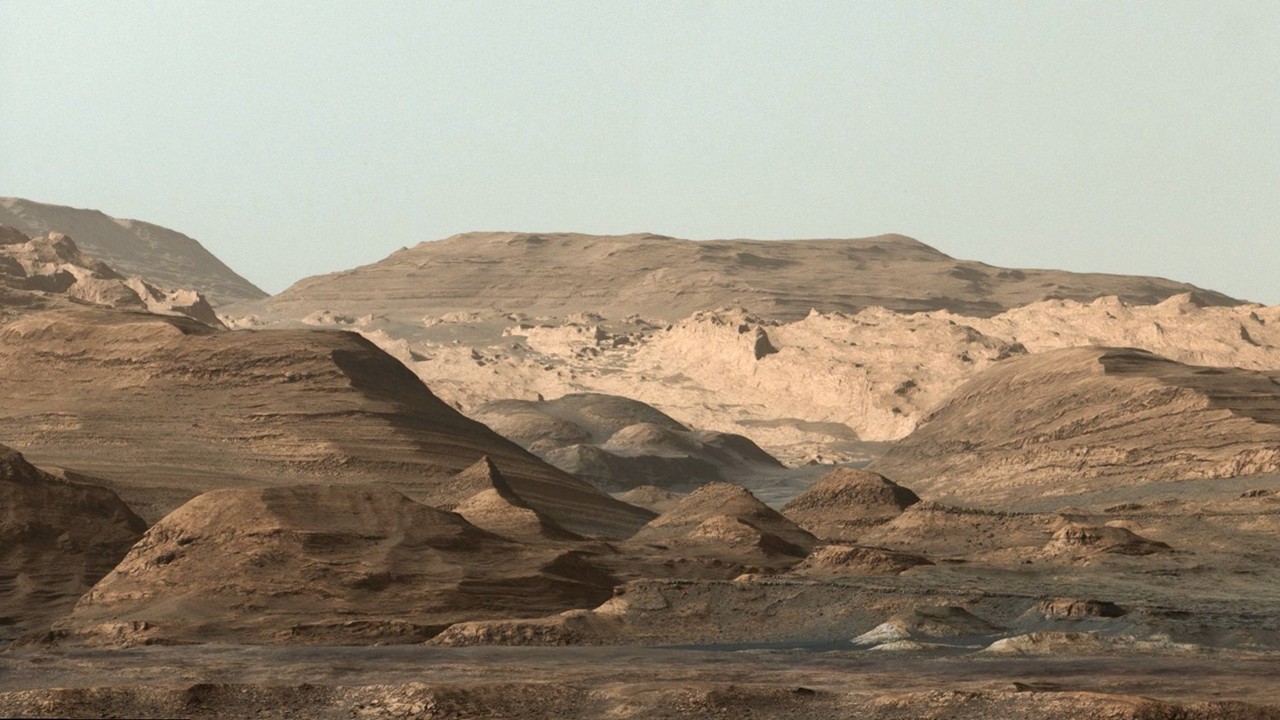
We identify Entities (O), Behaviors (B), and Emergents (e), then weigh Earth vs. Mars cues from the emergent structure and physical context.
3x3 analysis (O/B/e)
Entities (O)
- Regolith surface
- Rock fragment cluster
- Surface track imprint
- Shadow projection
Behaviors (B)
- Sediment redistribution
- Surface deformation (track formation)
- Light occlusion (shadow geometry)
Emergents (e)
- Surface patterning
- Directional path signature
- Depth perception from shadow contrast
[
  {
    "id": "TO001",
    "matrix_index": 0,
    "name": "Regolith Surface",
    "description": "Fine-grained dusty planetary soil covering terrain",
    "attributes": ["granular", "low cohesion", "oxidized"],
    "boundary_condition": "continuous ground layer",
    "part_classification": "proper",
    "metastability_measure": 0.72
  },
  {
    "id": "TO002",
    "matrix_index": 1,
    "name": "Rock Fragments / Boulders",
    "description": "Scattered lithic fragments embedded in regolith",
    "attributes": ["angular", "varied size", "erosion-shaped"],
    "boundary_condition": "discrete solid boundaries",
    "part_classification": "proper",
    "metastability_measure": 0.88
  },
  {
    "id": "TO003",
    "matrix_index": 2,
    "name": "Surface Track / Disturbance",
    "description": "Linear mechanical disturbance in soil",
    "attributes": ["linear", "shallow", "directional"],
    "boundary_condition": "localized deformation path",
    "part_classification": "transitional",
    "metastability_measure": 0.40
  },
  {
    "id": "TO004",
    "matrix_index": 3,
    "name": "Shadow Projection",
    "description": "Triangular shadow cast across surface",
    "attributes": ["optical", "geometric", "light-dependent"],
    "boundary_condition": "light occlusion boundary",
    "part_classification": "improper",
    "metastability_measure": 0.12
  }
]
Why this suggests Mars
- Fine, uniform regolith with oxidized tones and no vegetation
- Rover-like track imprint and hardware-like shadow geometry
- Minimal atmospheric haze and no moisture/weathering cues
Verdict: Mars
Correct identification: Yes
Detailed Analysis
Key Relationships
| ID0 | Description | Relationship | ID1 | Description |
|---|---|---|---|---|
| TO001 | Regolith Surface | DRIVES | TB001 | Sediment Redistribution |
| TO002 | Rock Fragment Cluster | FCILITATES | Te001 | Surface Patterning |
| TO003 | Surface Track Imprint | RESULTS_IN | Te002 | Directional Path Signature |
| TO004 | Shadow Projection | RESULTS_IN | Te003 | Spatial Depth Perception |
| TB002 | Surface Deformation | PRODUCES | TO003 | Surface Track Imprint |
| TB003 | Light Occlusion | PRODUCES | TO004 | Shadow Projection |
Insights
-
No biological or adaptive MIEN structures → purely physical-geophysical system.
-
Emergence is perceptual + structural, not agent-based:
- Patterns, depth, directionality are emergent phenomena.
- Track imprint = transitional object:
- Will decay via entropy (wind erosion, sediment flow).
- Shadow = improper part:
- Exists within boundary but not functionally integrated.
- Entropy driver:
- Soil redistribution + erosion = irreversible state change (ΔS ≥ 0).
Summary Interpretation
This photograph contains a non-adaptive physical system where:
- Objects (O) = soil, rocks, tracks, shadow
- Behaviors (B) = deformation, sediment flow, light occlusion
- Emergents (e) = terrain patterning, directional meaning, spatial depth
All emergents arise from mechanism–entity interactions:
- gravity + regolith → flow
- pressure + soil → track
- light + occlusion → shadow
- contrast + geometry → depth perception
Which is fully consistent with the 3×3 logic structure and MIEN principles (mechanism-driven emergence without adaptive agency).
It’s much more likely to be Mars than Earth.
Why Mars (vs. Earth)
- The scene is a dry, fine-grained regolith plain with scattered rocks and no vegetation or biological/anthropogenic texture.
- The reddish dust tone and overall “clean” atmosphere (no haze layers, no moisture cues) match typical Mars surface imagery.
- The sharp triangular shadow plus the faint linear surface disturbances are very consistent with a rover (or its hardware) casting a shadow and leaving wheel/track marks on dusty regolith. On Earth, you’d usually get additional context (plants, pebbles with water-weathering, mixed minerals, footprints with different compaction signatures, etc.).
Where on Mars (best guess)
With only this one image and no metadata, I can’t uniquely identify a precise spot. But the terrain looks like a broad, relatively flat plains environment that’s been wheel-traversed—which strongly suggests a classic rover traverse scene.
If I have to pick one location that best matches the “flat dusty plain + scattered small rocks + track-mark-friendly surface,” my top guess is:
- Meridiani Planum (Opportunity rover region), possibly on/near the plains approaching or around Endeavour Crater.
- Confidence: medium on Mars, low on exact location.