
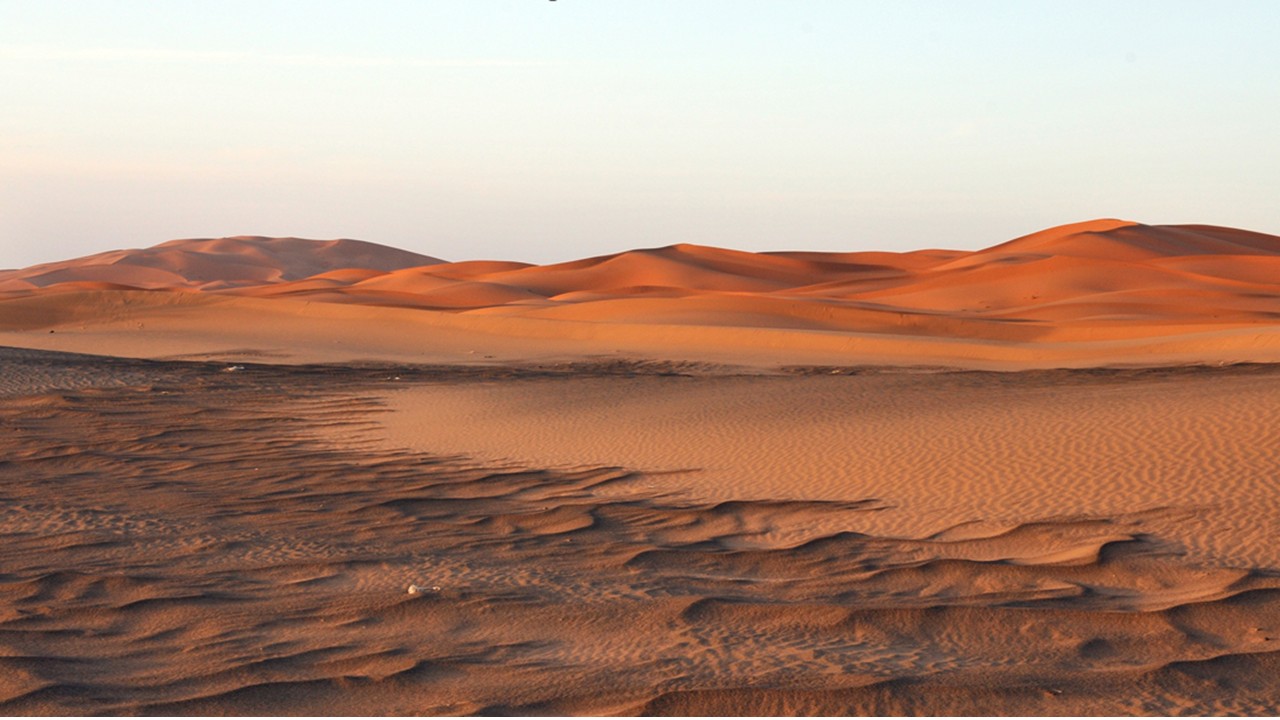
Methodology (3x3)
We identify Entities (O), Behaviors (B), and Emergents (e), then compare the emergent cues to Earth/Mars signatures.
3x3 analysis (O/B/e)
Entities (O)
- Sand dune field
- Rippled sand surface
- Sediment layers
- Solar illumination field
Behaviors (B)
- Aeolian transport
- Dune migration
- Surface heating
Emergents (e)
- Dune morphology
- Flow direction field
- Stratified landscape memory
Why this suggests Earth
- Blue sky and atmospheric haze consistent with Earth
- Warm orange dune color common to terrestrial sand seas
- Ripple scale and texture match human-scale desert imagery
Verdict: Earth
Correct identification: Yes
Detailed Analysis
[
  {
    "id": "TO001",
    "matrix_index": 0,
    "name": "Sand Dune Field",
    "description": "Large-scale aeolian dune formations",
    "attributes": ["fine-grained", "wind-shaped", "layered"],
    "boundary_condition": "dune ridgeline boundaries",
    "part_classification": "proper",
    "metastability_measure": 0.80
  },
  {
    "id": "TO002",
    "matrix_index": 1,
    "name": "Rippled Sand Surface",
    "description": "Fine ripple textures on sand surface",
    "attributes": ["periodic", "granular", "directional"],
    "boundary_condition": "surface-layer boundary",
    "part_classification": "proper",
    "metastability_measure": 0.65
  },
  {
    "id": "TO003",
    "matrix_index": 2,
    "name": "Sediment Layers",
    "description": "Stratified sand deposition layers",
    "attributes": ["stratified", "depositional", "historical"],
    "boundary_condition": "internal dune layering",
    "part_classification": "proper",
    "metastability_measure": 0.75
  },
  {
    "id": "TO004",
    "matrix_index": 3,
    "name": "Solar Illumination Field",
    "description": "Sunlight shaping contrast, heat, and shadow",
    "attributes": ["directional", "thermal", "optical"],
    "boundary_condition": "illumination boundary",
    "part_classification": "improper",
    "metastability_measure": 0.15
  },
  {
    "id": "TB001",
    "matrix_index": 4,
    "name": "Aeolian Transport",
    "description": "Wind-driven movement of sand particles",
    "attributes": ["continuous", "directional", "low-energy"],
    "boundary_condition": "dune field",
    "frequency_measure": "constant"
  },
  {
    "id": "TB002",
    "matrix_index": 5,
    "name": "Dune Migration",
    "description": "Net movement of dune structures over time",
    "attributes": ["slow", "irreversible", "directional"],
    "boundary_condition": "landscape scale",
    "frequency_measure": "slow-continuous"
  },
  {
    "id": "TB003",
    "matrix_index": 6,
    "name": "Surface Heating",
    "description": "Thermal absorption and radiation by sand",
    "attributes": ["radiative", "diurnal", "gradient-driven"],
    "boundary_condition": "surface interface",
    "frequency_measure": "daily"
  },
  {
    "id": "Te001",
    "matrix_index": 7,
    "name": "Dune Morphology",
    "description": "Large-scale organized dune geometry",
    "attributes": ["self-organized", "coherent", "patterned"],
    "boundary_condition": "entire dune system",
    "emergence_strength": 0.90
  },
  {
    "id": "Te002",
    "matrix_index": 8,
    "name": "Flow Direction Field",
    "description": "Emergent directional structure of wind flow",
    "attributes": ["vector coherence", "directional alignment"],
    "boundary_condition": "regional terrain",
    "emergence_strength": 0.85
  },
  {
    "id": "Te003",
    "matrix_index": 9,
    "name": "Stratified Landscape Memory",
    "description": "Emergent record of deposition history in layers",
    "attributes": ["temporal encoding", "sedimentary memory"],
    "boundary_condition": "dune interior structure",
    "emergence_strength": 0.82
  }
]
Key Relationships
| ID0 | Description | Relationship | ID1 | Description |
|---|---|---|---|---|
| TO004 | Solar Illumination Field | FACILITATES | TB003 | Surface Heating |
| TB003 | Surface Heating | FACILITATES | TB001 | Aeolian Transport |
| TB001 | Aeolian Transport | PRODUCES | TB002 | Dune Migration |
| TB002 | Dune Migration | RESULTS_IN | Te001 | Dune Morphology |
| TB001 | Aeolian Transport | RESULTS_IN | Te002 | Flow Direction Field |
| TO003 | Sediment Layers | RESULTS_IN | Te003 | Stratified Landscape Memory |
Insights
- Pure aeolian emergence system
All structure arises from wind–sand interactions (no biological or adaptive agents).
- Entropy-dominant dynamics
Migration + erosion + deposition = irreversible system evolution (ΔS ≥ 0).
- Emergence is geometric and structural
Patterns are self-organized, not designed.
- Strong physical coherence
Dune fields encode long-term environmental history through layering and morphology.
Interpretation Summary
This photograph contains a mechanism-driven natural system where:
- Objects: sand, layers, dunes, sunlight
- Behaviors: wind transport, migration, heating
- Emergents: dune geometry, directional flow fields, sedimentary memory
All forms arise from mechanism–entity interactions:
- wind + sand → transport
- transport → migration
- migration → morphology
- deposition → structure
This is a textbook 3×3 physical emergence system (non-MIEN, aeolian geomorphology).
This one is almost certainly Earth, not Mars.
Why Earth
- Blue sky gradient + atmospheric haze: Mars skies in daylight are typically butterscotch/tan and the horizon haze behaves differently. This looks like Earth’s Rayleigh-scattered blue sky.
- Dune color and lighting: The saturated orange/red dunes plus crisp, warm low-angle sunlight is very characteristic of terrestrial sand seas (ergs).
- Foreground ripple scale: The small ripples and surface texture match common Earth aeolian sand ripples at human/camera scale.
Where on Earth (best guesses)
From the look—large smooth dunes, orange sand, sparse/no vegetation in frame—this resembles a major sand sea (erg). Top candidates:
- Sahara Desert
- Erg Chebbi (near Merzouga, Morocco) or Erg Chigaga (Morocco)
- Very common photographic look: orange dunes + clean horizons.
- Arabian Peninsula
- Rub’ al Khali (Empty Quarter) (Saudi Arabia / UAE / Oman)
- Massive dune fields with similar color and forms.
- Namib Desert
- Namib Sand Sea (around Sossusvlei, Namibia)
- Also famous for orange dunes, though many scenes include darker gravel plains or distinctive contrast; still plausible.
My single best pick
Sahara (Morocco, Erg Chebbi / Merzouga area) — mainly because this exact “orange dune + blue sky + clean wind-rippled foreground” composition is extremely typical of that region’s imagery.