Methodology (3x3)
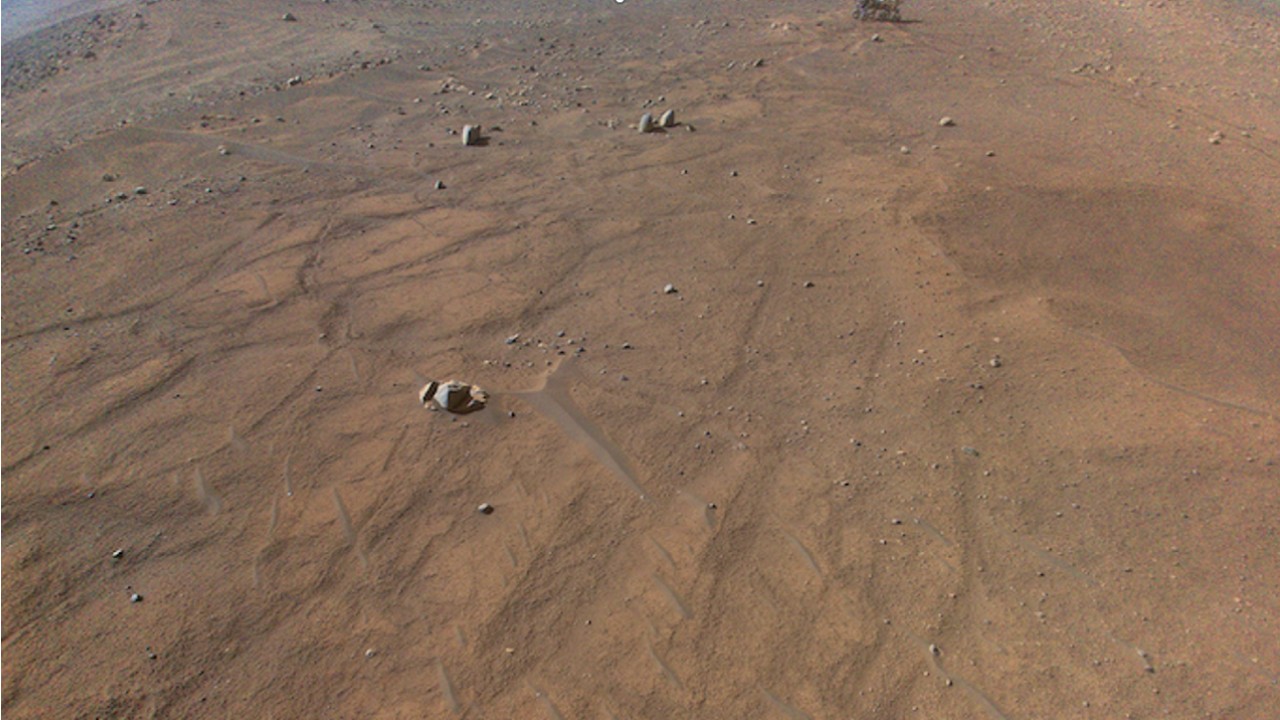
We identify Entities (O), Behaviors (B), and Emergents (e), then assess whether the emergent structure implies Earth or Mars.
3x3 analysis (O/B/e)
Entities (O)
- Regolith plain
- Rock fragments
- Track or disturbance line
- Hard-edged shadow region
Behaviors (B)
- Sediment settling and redistribution
- Mechanical disturbance (track formation)
- Light occlusion
Emergents (e)
- Terrain texture signature
- Directional path cue
- Depth perception from contrast
Why this suggests Mars
- Dry regolith surface with angular rocks and no vegetation
- Geometric shadow likely cast by rover hardware
- Rover-style track disturbance without terrestrial context
Verdict: Mars
Correct identification: Yes
Detailed analysis
3x3 Model
[
  {
    "id": "TO001",
    "matrix_index": 0,
    "name": "Regolith Surface",
    "description": "Fine-grained dusty planetary soil covering terrain",
    "attributes": ["granular", "low cohesion", "oxidized"],
    "boundary_condition": "continuous ground layer",
    "part_classification": "proper",
    "metastability_measure": 0.72
  },
  {
    "id": "TO002",
    "matrix_index": 1,
    "name": "Rock Fragments / Boulders",
    "description": "Scattered lithic fragments embedded in regolith",
    "attributes": ["angular", "varied size", "erosion-shaped"],
    "boundary_condition": "discrete solid boundaries",
    "part_classification": "proper",
    "metastability_measure": 0.88
  },
  {
    "id": "TO003",
    "matrix_index": 2,
    "name": "Surface Track / Disturbance",
    "description": "Linear mechanical disturbance in soil",
    "attributes": ["linear", "shallow", "directional"],
    "boundary_condition": "localized deformation path",
    "part_classification": "transitional",
    "metastability_measure": 0.40
  },
  {
    "id": "TO004",
    "matrix_index": 3,
    "name": "Shadow Projection",
    "description": "Triangular shadow cast across surface",
    "attributes": ["optical", "geometric", "light-dependent"],
    "boundary_condition": "light occlusion boundary",
    "part_classification": "improper",
    "metastability_measure": 0.12
  },
  {
    "id": "TB001",
    "matrix_index": 4,
    "name": "Aeolian Dust Transport",
    "description": "Wind-driven redistribution of fine particles",
    "attributes": ["continuous", "directional", "low-energy"],
    "boundary_condition": "entire surface",
    "frequency_measure": "constant"
  },
  {
    "id": "TB002",
    "matrix_index": 5,
    "name": "Mechanical Surface Deformation",
    "description": "Soil displacement by external mechanical force",
    "attributes": ["localized", "linear", "pressure-driven"],
    "boundary_condition": "track zone",
    "frequency_measure": "rare"
  },
  {
    "id": "TB003",
    "matrix_index": 6,
    "name": "Thermal Weathering",
    "description": "Material breakdown due to temperature cycling",
    "attributes": ["cyclic", "stress-inducing", "irreversible"],
    "boundary_condition": "rock and soil surfaces",
    "frequency_measure": "daily"
  },
  {
    "id": "Te001",
    "matrix_index": 7,
    "name": "Surface Pattern Field",
    "description": "Large-scale visual texture of regolith and rocks",
    "attributes": ["spatial coherence", "terrain identity"],
    "boundary_condition": "entire visible terrain",
    "emergence_strength": 0.80
  },
  {
    "id": "Te002",
    "matrix_index": 8,
    "name": "Directional Path Signature",
    "description": "Emergent perception of movement/path from linear disturbance",
    "attributes": ["directionality", "trajectory implication"],
    "boundary_condition": "track axis",
    "emergence_strength": 0.78
  },
  {
    "id": "Te003",
    "matrix_index": 9,
    "name": "Topographic Depth Perception",
    "description": "Emergent 3D depth from light-shadow interaction",
    "attributes": ["depth cue", "scale inference"],
    "boundary_condition": "shadow/light interface",
    "emergence_strength": 0.76
  }
]
Key Relationships
| ID0 | Description | Relationship | ID1 | Description |
|---|---|---|---|---|
| TO001 | Regolith Surface | FACILITATES | TB001 | Aeolian Dust Transport |
| TB001 | Aeolian Dust Transport | RESULTS_IN | Te001 | Surface Pattern Field |
| TB002 | Mechanical Surface Deformation | PRODUCES | TO003 | Surface Track |
| TO003 | Surface Track | RESULTS_IN | Te002 | Directional Path Signature |
| TO004 | Shadow Projection | RESULTS_IN | Te003 | Topographic Depth Perception |
| TO002 | Rock Fragments | FACILITATE | Te001 | Surface Pattern Field |
Insights
- Pure physical emergence system
No biological or adaptive agency — only physics.
- Mechanism-driven structure
Patterns arise from wind, impact, and mechanical interaction.
- Entropy-dominant evolution
All processes are irreversible: erosion, dust transport, weathering.
- Emergence types
- Visual emergence (pattern fields)
- Structural emergence (terrain coherence)
- Perceptual emergence (path + depth inference)
This one is much more likely Mars than Earth.
Why Mars
- No sky / no atmospheric cues in-frame, but the color and surface texture match typical Mars rover panoramas: dusty regolith with scattered angular rocks and subtle wind-sculpted streaking.
- The very crisp, geometric triangular shadow is strongly suggestive of spacecraft hardware (rover/lander appendage) casting a shadow. That’s a common signature in Mars surface images; on Earth you’d almost always have other contextual cues (vegetation, mixed sediment types, moisture effects, human debris/footprints, etc.).
- The linear surface disturbances look like rover wheel tracks rather than natural cracks or animal/human traffic patterns.
Where on Mars (best guess)
I can’t uniquely pin it down, but the scene looks like a flat basaltic/regolith plain typical of the two classic MER landing regions.
My best single pick:
Meridiani Planum (Opportunity rover region)
Reason: the combination of flat, dusty plain + scattered small rocks + evident track-like disturbances is very consistent with long Opportunity traverses across Meridiani’s plains.
Secondary plausible alternative:
- Gusev Crater plains (Spirit rover region) — also fits the “rocky basaltic plain” look.
Confidence
- Mars vs Earth: high
- Exact location on Mars: low–medium (Meridiani vs Gusev being the main ambiguity)