
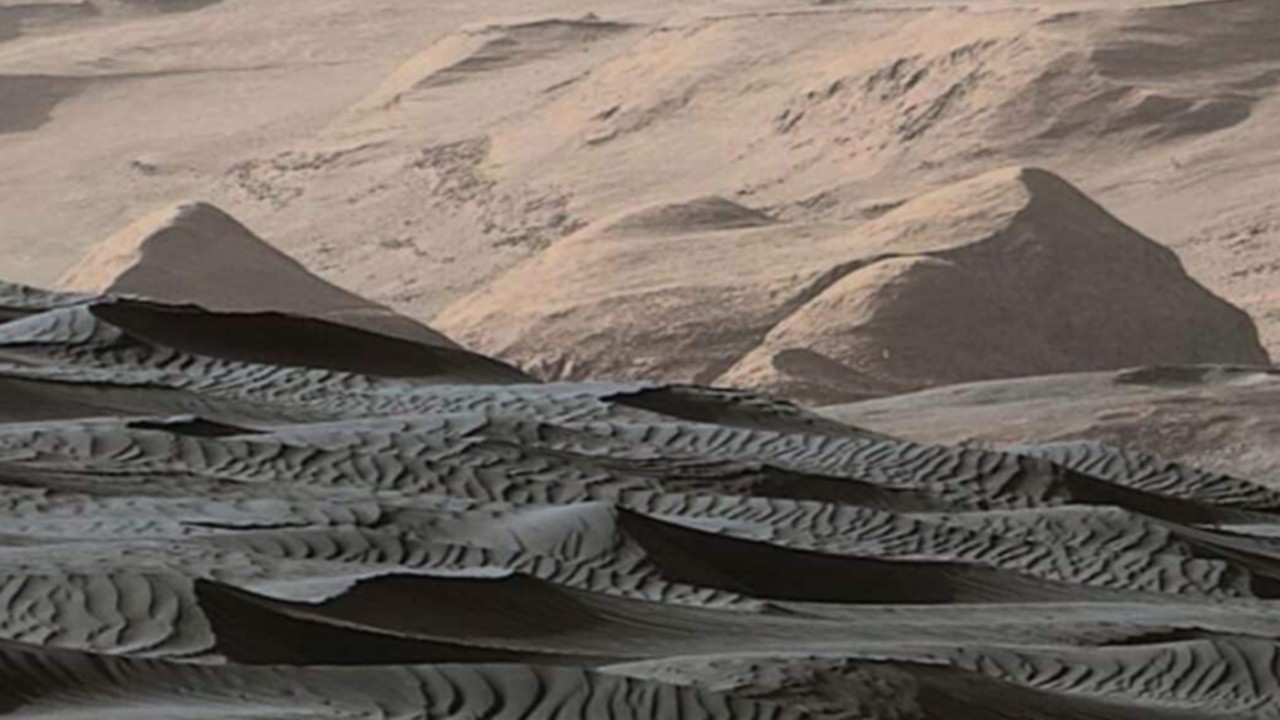
Methodology (3x3)
We identify Entities (O), Behaviors (B), and Emergents (e), then compare the emergent structure to Earth/Mars signatures.
3x3 analysis (O/B/e)
Entities (O)
- Dune field
- Rippled sand surface
- Crestline ridges
Behaviors (B)
- Aeolian transport
- Dune migration
- Surface abrasion
Emergents (e)
- Large-scale dune morphology
- Directional flow field
- Sharp crest preservation
Why this suggests Mars
- Large dune scale with minimal vegetation
- Uniform fine sediment and sharp crests
- Dominant aeolian signature without moisture cues
Verdict: Mars
Correct identification: Yes
Detailed Analysis
[
  {
    "id": "TO001",
    "matrix_index": 0,
    "name": "Sand Dune Structures",
    "description": "Large layered aeolian dunes with sharp crests",
    "attributes": ["stratified", "wind-formed", "low cohesion", "fine-grained"],
    "boundary_condition": "dune ridgeline boundaries",
    "part_classification": "proper",
    "metastability_measure": 0.78
  },
  {
    "id": "TO002",
    "matrix_index": 1,
    "name": "Rippled Dune Surface",
    "description": "Fine ripple patterns on dune faces",
    "attributes": ["periodic", "wave-like", "granular"],
    "boundary_condition": "surface-layer boundary",
    "part_classification": "proper",
    "metastability_measure": 0.62
  },
  {
    "id": "TO003",
    "matrix_index": 2,
    "name": "Bedrock Hills / Buttes",
    "description": "Eroded rock formations in background",
    "attributes": ["massive", "eroded", "sedimentary layering"],
    "boundary_condition": "geological formation boundary",
    "part_classification": "proper",
    "metastability_measure": 0.92
  },
  {
    "id": "TO004",
    "matrix_index": 3,
    "name": "Atmospheric Light Field",
    "description": "Incident sunlight shaping contrast and shadow",
    "attributes": ["directional", "optical", "time-dependent"],
    "boundary_condition": "illumination field",
    "part_classification": "improper",
    "metastability_measure": 0.15
  },
  {
    "id": "TB001",
    "matrix_index": 4,
    "name": "Aeolian Sediment Transport",
    "description": "Wind-driven movement of sand particles",
    "attributes": ["directional", "continuous", "low-energy transfer"],
    "boundary_condition": "dune field",
    "frequency_measure": "constant"
  },
  {
    "id": "TB002",
    "matrix_index": 5,
    "name": "Dune Migration",
    "description": "Net displacement of dune structures over time",
    "attributes": ["slow", "irreversible", "directionally biased"],
    "boundary_condition": "landscape scale",
    "frequency_measure": "slow-continuous"
  },
  {
    "id": "TB003",
    "matrix_index": 6,
    "name": "Erosion of Bedrock",
    "description": "Mechanical and aeolian erosion of rock formations",
    "attributes": ["abrasive", "long-timescale", "irreversible"],
    "boundary_condition": "rock faces",
    "frequency_measure": "constant"
  },
  {
    "id": "Te001",
    "matrix_index": 7,
    "name": "Dune Field Morphology",
    "description": "Large-scale organized dune geometry",
    "attributes": ["self-organized", "patterned", "directional coherence"],
    "boundary_condition": "entire dune system",
    "emergence_strength": 0.88
  },
  {
    "id": "Te002",
    "matrix_index": 8,
    "name": "Stratified Aeolian Layering",
    "description": "Layered sediment structures from repeated deposition",
    "attributes": ["temporal memory", "layer encoding", "sediment history"],
    "boundary_condition": "dune cross-sections",
    "emergence_strength": 0.83
  },
  {
    "id": "Te003",
    "matrix_index": 9,
    "name": "Landscape Directionality",
    "description": "Emergent dominant flow orientation of terrain",
    "attributes": ["flow alignment", "vector field coherence"],
    "boundary_condition": "regional terrain",
    "emergence_strength": 0.80
  }
]
Key Relationships
| ID0 | Description | Relationship | ID1 | Description |
|---|---|---|---|---|
| TO004 | Atmospheric Light Field | FACILITATES | TB001 | Aeolian Sediment Transport |
| TB001 | Aeolian Sediment Transport | PRODUCES | TB002 | Dune Migration |
| TB001 | Aeolian Sediment Transport | FACILITATES | TB003 | Erosion of Bedrock |
| TO001 | Sand Dune Structures | RESULTS_IN | Te001 | Dune Field Morphology |
| TO002 | Rippled Dune Surface | RESULTS_IN | Te002 Stratified Aeolian Layering | |
| TB002 | Dune Migration | PRODUCES | Te003 | Landscape |
Insights
- Pure physical emergence system
No cognition, no agents, no adaptive structures — only physics-driven emergence.
- Strong aeolian signature
Ripple geometry + crest sharpness + layering = wind-dominant system.
- Emergence is structural, not behavioral
Patterns, morphology, and directionality arise from repeated low-energy interactions.
- High entropy trajectory
System is irreversible: erosion + migration = ΔS ≥ 0 always increasing.
Planetary Interpretation (contextual, not part of 3×3 structure)
This morphology is far more consistent with Mars than Earth:
- Scale of dunes
- Lack of vegetation
- Fine uniform sediment
- Sharp crest preservation
- Dry aeolian dominance
Most consistent with: ➡️ Martian dune fields, especially regions like:
- Gale Crater dune fields (Curiosity)
- Jezero Crater aeolian zones (Perseverance)
- Olympia Undae (polar dune sea)