
Most AI systems describe what they see. The 3x3 framework understands what could happen next.
Here is a simple image. A longboard resting on a sidewalk near a curb.
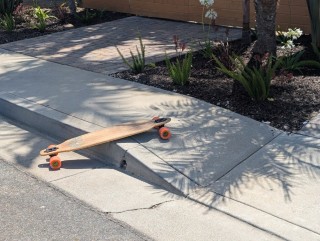
A standard AI system looks at this and reports: “A skateboard on a sidewalk.”
That is accurate. It is also almost useless.
What the framework sees instead
The framework does not start with the object. It starts with the situation — the objects, the forces acting on them, and the outcomes those forces could produce.
What is in the scene:
- A longboard on wheels, resting in an unstable position at the edge of a curb
- A slope leading from the sidewalk down to the street
- A street with vehicle and cyclist traffic
What could happen next:
- The board rolls off the curb into the street — triggered by a passing pedestrian, a gust of wind, a cyclist brushing it, or nothing at all
- A driver swerves to avoid it
- A cyclist makes an emergency maneuver
- A pedestrian trips on it
Why it matters: The frame contains no drivers, no cyclists, no pedestrians. A description-based system sees none of those agents because they are not present. The framework finds them anyway — because the situation creates the expectation of their arrival, and the board’s position creates a hazard for each of them.
Why this matters beyond a sidewalk
The skateboard is a deliberately simple example. The same analytical move — from description to dynamic situation — is what the framework applies to a market, a supply chain, an organization, or a technology system.
In each case, the question is not “what is here?” The question is “what forces are acting on this, what can change, and what happens when it does?”
That is the advantage. Not better object recognition. A different question.
For the methodology in plain English, see The 3x3 framework, explained →. To discuss an application to your own system, get in touch →.